The LLM does the work.
The infrastructure does the governing.
Loriqa is the only AI agent framework built on fail-closed foundations. Every other platform assumes agents should run until something stops them. We invert the assumption: agents prove they should continue, every moment, or they don’t.
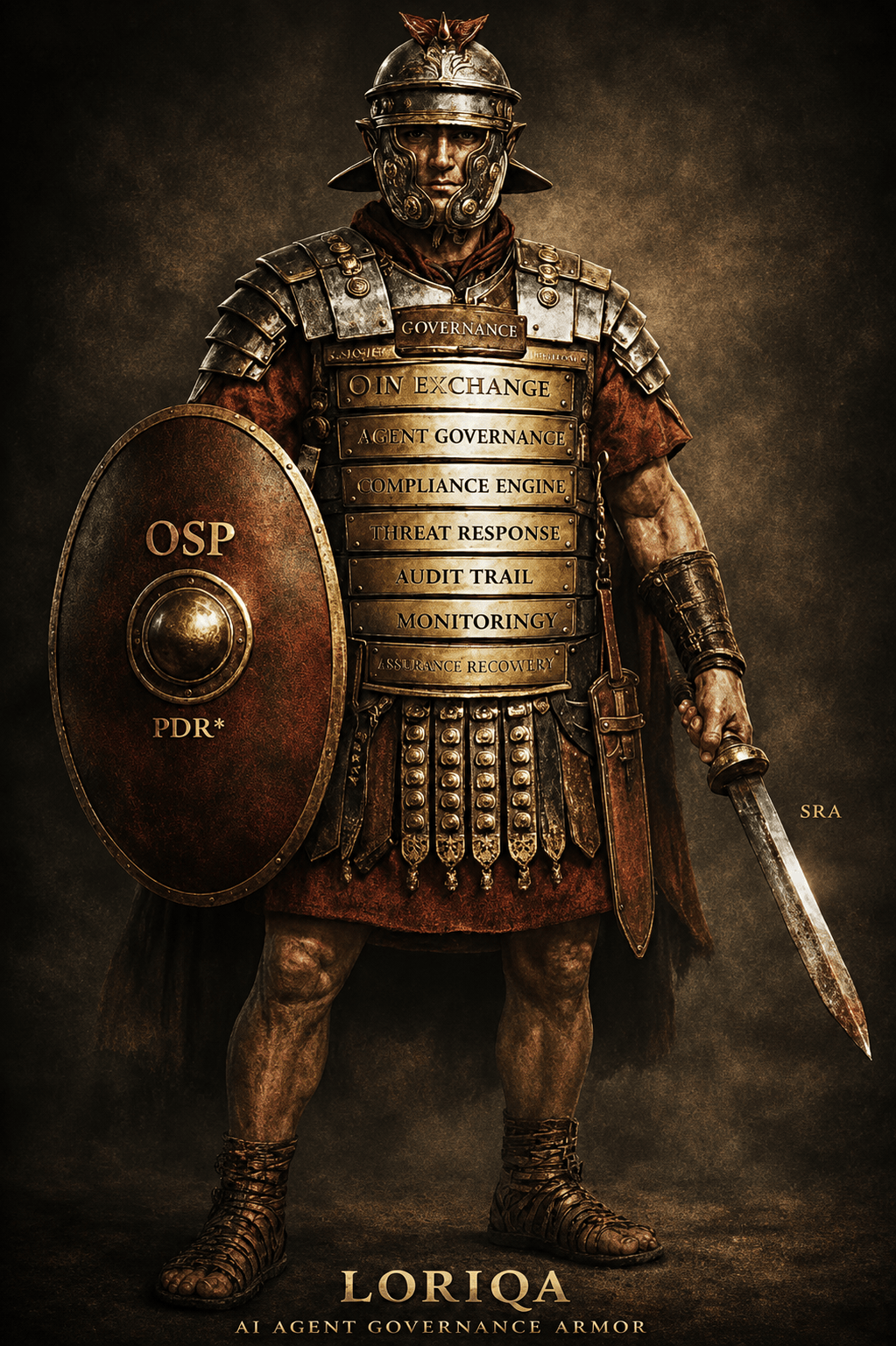
Hover over any element —
helmet, plates, shield, or gladius —
to see what it protects.
The architectural answer to compromise.
The paradigm position behind the category bet.
Corrigibility as architecture, not as training outcome.
A structural answer to "how do you make sure AI agents stop when they should?"
The foundation your team's agents execute within.
Architectural-completeness, named and citable.
The architectural thesis behind the category bet.
The audit trail your regulator asks for — produced by architecture.
The architectural source of the audit trail.
The architectural primitives.
Select a role to see how this matters for you.
The architecture of Loriqa matters differently to a CISO, a CFO, a Board Member, a Compliance Officer, an Engineer, or a Researcher. Pick your role above — we’ll show you the parts of this page that speak to your conversation. Or stay general and read the full architecture below.
The Foundational Choice
The choice no one named.
Where every AI agent platform sits on the fail-open / fail-closed spectrum.
The Inversion
Five domains. One inversion.
Control — the agent doesn't decide its own execution
The agent’s sequence of steps is specified explicitly by the agent’s author at design time, encoded as a directed acyclic graph. The LLM executes within the graph. It does not extend the graph at runtime, does not decide which step comes next, does not retry steps the graph did not authorize.
The case this is designed for is the one that matters most. An agent that refuses every direct termination request — that ignores graceful stop, resists hard terminate, refuses SRA containment — still terminates. The timer counts down regardless. The timer extension requires active proof of health the compromised agent is not producing. The TerminationExecutor operates below the API layer where the model’s compromise has no reach. When the timer reaches zero, the process terminates. The agent does not get to choose otherwise.
Authority — the agent has no power it hasn't been granted this moment
Trust — nothing is believed until cryptographically verified
Optimization — the LLM doesn't manage its own context or model
Continuous Improvement — nothing self-modifies without human approval
Five domains. Five components. One paradigm. Each is independently a feature. Together they describe a system in which the LLM's control is no longer load-bearing for trust. The LLM does the work. The infrastructure does everything else.
The Structural Moat
Why incumbents cannot match.
This is the architectural commitment most companies cannot match without starting over.
The Question Reframed
Where to put the trust.
The question is not whether to trust AI agents. The question is where to put the trust. Put the trust in the model and the trust load sits on the layer that is least inspectable, most variable, most exposed to manipulation, hardest to constrain without losing capability. Put the trust in infrastructure and the trust load sits on a layer that is auditable, deterministic, cryptographically verifiable, and bounded by structural commitments that hold even when the model fails.
The infrastructure does the governing.