The Forum

The governance gap is not a future risk. It is a present failure.

AI tools are already inside your institution. Some you sanctioned. Some were adopted quietly. Some may be running today without your knowledge. How many are fully auditable, governed, and compliant — right now?
Every deployment fully governed. Every agent action protected. Every incident documented. Every decision explained.

I

Every agent action recorded in a tamper-proof cryptographic chain.

II

No agent executes in violation of regulatory or security policies in effect.

III

Security is built into the foundation, not bolted on afterwards.

IV

Threats are contained in milliseconds before damage can be done.

The Governance Gap

The industry knows the problem. The numbers are not ambiguous. What’s missing is architecture — not awareness.

40%

of organizations experienced an AI privacy breach or security incident

Gartner

81%

experienced API security incidents — yet only 14.4% feel fully prepared

Gravitee

73%

of security professionals concerned about AI threats — only 30% have governance

NeuralTrust

1 in 4

organizations have already experienced an AI-related security incident

Cloud Security Alliance

1 in 5

reported a data breach or security incident linked to AI usage

Deloitte

79%

of organizations expect an AI-related security incident within the next year

EMA Research

These are not edge cases. This is the baseline.
That’s the problem IV was built to solve.

Who We Are

InviolableVeritas — a truth that cannot be violated — was founded on a single conviction: that AI governance, security, accountability, and clarity must be architectural decisions made before a line of code is written.

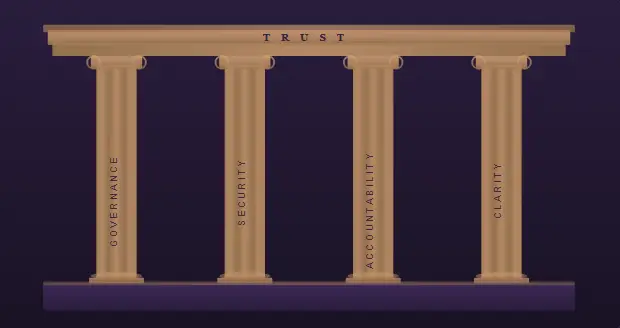
The IV mark is not just our initials. The Roman numeral IV represents our founding pillars — the four properties that, together, produce trust.

We believe the organizations building AI technology carry an obligation that extends beyond their product.
IV meets that obligation directly — through our product, through open governance standards, and through programs designed to prepare society for the changes already underway.
The IV Minute Update

The IV Minute Update

Research

Why AI Alignment Fails: The Retrofit Problem

The VII structural problems with current LLM alignment — through the lens of developmental psychology.

Read Article →
Compliance

SOC II and HIPAA in the age of autonomous agents

Compliance frameworks weren’t built for non-deterministic software.

Coming Soon
Industry Analysis

Regulated industries and AI: compliance is a procurement gate

Governance isn’t a feature — it’s a precondition.

Coming Soon
IV — InviolableVeritas | Security for the age of AI
The Architect's Table

Open Security Posture &
the PDR³ Lifecycle

Open Security Posture (OSP) is an architectural commitment — every governance component is inspectable, every decision is traceable, every claim is verifiable. The PDR³ lifecycle is a continuous cycle. The superscript ³ encodes the three R phases — the reactive arc. Prevention and Detection form the proactive arc. Reinforcement feeds back into Prevention. The posture entering each cycle is stronger than the one before.

LIFECYCLE PDR³ PROACTIVE REACTIVE ARC — R³ P PREVENTION D DETECTION RESPONSE RECOVERY REINFORCEMENT
P Prevention Proactive

Prevention establishes the security posture before any agent executes. Every agent passes a five-gate Deployment Promotion Pipeline (DPA) — static validation, security assessment, compliance evaluation, confidence scoring, and final certification.

The Final Assessment Agent (FAA) produces a cryptographic confidence score across the IV pillars. Agents scoring below threshold are blocked. The Regulatory Compliance Agent (RCA) evaluates definitions against active regulation packs in real time.

DPA FAA RCA RBAC

The EventStore: Tamper-Proof by Architecture

Every agent action is recorded in an append-only EventStore secured by an HMAC-SHA256 chain. Each record is cryptographically signed at write time and linked to the previous. A single tampered entry breaks the chain — and that break is immediate, detectable, and irrefutable.

Intent
TOOL_CALL_INTENDED
hmac: 7f3a…c2d1
Execution
Tool Call Result
hmac: a1b8…9e4f
Decision
Action Taken
hmac: d4c2…6b8a
Sealed
Record Committed
hmac: 2e7f…1a3d

Completeness

TOOL_CALL_INTENDED written before every execution. Intent is recorded even if the action never completes.

Authenticity

HMAC-SHA256 signatures computed at write time. Independently verifiable without application access.

Non-repudiation

Every record carries agent identity, operator identity, and timestamp. Multi-party accountability is structural.

Integrity

Append-only at database level. No update. No delete. Chain break = immediate violation detection.

The Armory

Lorica — AI agent governance,
forged in architecture.

Named for the segmented armor that made the Roman legions unstoppable. Each plate a capability. Each layer a protection.

Hover or tap any element to explore

Lorica

Lorica legionnaire image

Save as lorica.jpg in the same folder,
then refresh — or drag & drop here.

Explore the Armor

Hover over any element —
helmet, plates, shield, or gladius —
to see what it protects.

The Theater

CVR Theater

Causal-Violation Replay — every agent action, every governance decision, every breach contained, reconstructible from the HMAC-verified EventStore.

Desktop Experience

Das CVR Theater ist eine interaktive Topologie mit über 50 Nodes, Live-Traffic-Animation und Breach-Replay. Für die volle Erfahrung empfehlen wir einen Bildschirm ab 900px Breite.

Ansicht auf Tablet oder Desktop
0s
Normal Ops Detection Governance Response ● UMBRA BREACH Resolution
CVR Replay CVR Theater Demo ⊙ 5:00:00 AM - 5:00:44 AM 99 events
★ Admin
SEARCH NODES
EVENT LAYERS
● Routine ● Governance ● Security ● Health ● GMS/MSA
EVENT TYPES
● Routine ● Governance ● Security ● Health ● Direct
ZONE D
MINIMAP
ZONE A — GOVERNANCE (PERMANENT) GMS MSA-S MSA-C MSA-P MSA-O PDA PFA-1 PFA-2 PFA-3 PFA-4 EMS CIA RCA SRA AIA QIA EPA FAA DPA ZONE B — SUB-AGENTS (GOVERNANCE-SPAWNED) DEF-1isolate DEF-2contain DEF-3standby EPA-M1 ZONE C — EXECUTION (DYNAMIC) EventStore DataProcessorstep: transform ReportBuilderstep: compile LogAnalyzerstep: ingest TRUST BOUNDARY ZONE D — GOVERNED ENVIRONMENTAL OPS (EMPIRE HEALTH SCIENCES) EPA → EMA deploy CLINICAL OPERATIONS CTMSPortal v4.2.1 EMA EDCData Capture EMA IRB PortalEthics Review EMA IVRSRandomization EMA LIMSLab Mgmt EMA LAB & CLINICAL DATA BiobankSpecimens EMA GenomicsSequencing EMA Safety DBPharmacovigilance EMA eCTDFDA Submissions EMA HL7/FHIRInterop Hub EMA INFRASTRUCTURE & EXTERNAL CDWData Warehouse EMA Patient PortalSubject-Facing EMA ClaimsInsurance/Billing EMA Device HubMed Telemetry EMA DMSDoc Mgmt EMA EMA (Endpoint Monitor) External Asset
100%
NODE DETAIL
Click any node or edge to inspect
|
99
0.25x0.5x1x2x5x10x | 5:00:08 AM
routine governance security health ⚡ direct monitoring

CVR — Cryptographically Verified Reconstruction

Most audit systems record what happened inside their platform. CVR proves what happened across your entire environment. Cryptographically Verified Reconstruction is not log replay. It is provable reconstruction — the difference between a witness statement and a court transcript signed under oath — extending across the trust boundary into your APIs, databases, cloud infrastructure, and third-party services.

Lorica operates a Four-Zone trust model. Zones A–C cover the platform — governance, agency operations, and customer agent execution. Zone D — Governed Environmental Operations — extends the HMAC chain beyond the platform boundary into the customer’s own infrastructure. The Environmental Protection Agency (EPA) deploys Environmental Monitoring Agents (EMAs) into your APIs, databases, cloud infrastructure, and third-party services. EMAs don’t just capture events — they learn your environment, build a tagged vocabulary of normal operations, and enable surgical precision that no blunt-force security tool can match. Every EMA event — tagged, classified, and baseline-aware — flows back through the same single HMAC chain

Four-Zone Unified Chain

Governance events (Zone A), agency operations (Zone B), agent execution (Zone C), and environmental operations (Zone D) are interleaved in a single HMAC chain. The sequence is the truth: E₁(governance) → E₂(agent) → E₃(capture) → E₄(enforce) → E₅(governance) → E₆(defend). No zone boundaries break the chain.

Environmental Intelligence

EMAs don’t just observe — they classify. Every captured event is tagged with a two-layer taxonomy: structural tags (traffic type, protocol, consumer identity, operation class) provide a consistent vocabulary across all deployments, while behavioral tags (learned baselines, frequency norms, temporal profiles, consumer patterns) provide environment-specific intelligence. The tags become the vocabulary that connects monitoring intelligence to management action — and gives PDA the cross-zone correlation capability no other platform can offer.

Surgical Management

The industry’s response to agent threats is amputation — shut down the service and sort it out later. EPA’s tag-based management enables surgical intervention: block the anomalous traffic pattern while preserving the service for legitimate consumers. Every management action is tag-targeted, time-scoped (auto-expires unless renewed), and reversible. Reversing a surgical cut takes seconds. Reversing an amputation takes days. The service never went down. The legitimate consumers never noticed.

EMA Maturity Progression

EMAs earn capabilities through governed promotion. ERL-1 (monitoring): capture, classify, learn baselines — purely observational. ERL-2 (management): tag-based surgical traffic control, subject to DPA governance and HITL checkpoints. ERL-3 (adaptive): presentation adapters for SIEMs, dashboards, ticketing systems, and custom integrations. Each tier requires DPA promotion. No EMA touches your infrastructure without first proving it can monitor it accurately.

CVR Theater

A dedicated forensic replay interface. Topology visualization shows the entire architecture in motion — agents, oversight, infrastructure — with events animating between nodes during playback. Moment in Time freezes the complete system state at any timestamp, including EMA baselines and deviation scores. Tag-based filtering lets you isolate specific traffic patterns, consumers, or anomaly classifications during replay. Transport controls from 0.25x forensic to 10x overview.

Verified Provenance

For every Zone D event, CVR verifies WHO reported or acted (identity verified by framework), WHAT was reported or enacted (signed into HMAC chain), WHEN it occurred (enrichment-stage timestamp), and HOW it was transformed (adaptation provenance captured). The one thing CVR does not guarantee: environment truthfulness itself. The EMA reports accurately. The environment may be adversarial. CVR is honest about this distinction.

Regulator-Ready Evidence

The document a regulator asks for is not a summary written after the fact. It is the actual execution record — platform and environment — cryptographically sealed at the time it occurred, replayed on demand with annotations as first-class compliance evidence. Export at three redaction levels: full detail, management summary, and external sharing.

Tamper Detection by Design

Because each HMAC incorporates the previous signature across all four zones, any modification — insertion, deletion, or alteration of a single event in any zone — invalidates every subsequent signature. Tampering with an environmental event breaks the governance chain. Tampering with a governance event breaks the environmental chain. There is no safe place to alter the record.

Every other platform asks you to trust their logs about what happened inside their product. CVR lets you verify what happened across your entire environment — platform, agents, APIs, databases, infrastructure, and third-party services — in a single cryptographic chain. EMAs learn your environment, tag your traffic, detect anomalies across the trust boundary, and respond with surgical precision. Not “what probably happened.” Verification of what actually happened.

Agent Lifecycle Security: Born Governed, Continuously Proven, Self-Destructing by Default

Traditional security assumes software is trusted once deployed. Lorica inverts this — agents are untrusted by default and must continuously prove they deserve to keep running. Every agent operates under a countdown timer. When the timer expires, the agent self-destructs. The only way to extend the timer is to pass a full health and security check. A compromised agent cannot persist because it cannot fake the proof.

Four-Layer Injection Scrubbing

Every input passes through four independent scrubbing layers before reaching agent reasoning. Prompt injection — the single most common attack vector against agentic AI — must survive all four stages. Each layer uses a different detection strategy: pattern matching, semantic analysis, structural validation, and contextual anomaly detection. Layered defence means a novel injection technique that evades one layer is caught by another.

Countdown Heartbeat

Every agent runs on a ticking clock. The Heartbeat Dead Man’s Switch requires agents to actively prove health at defined intervals — not just “I’m alive” but “I am healthy, uncompromised, and operating within my governance profile.” Failure to prove health before the countdown expires triggers automatic self-destruction. No graceful degradation. No zombie agents.

Continuous Security Verification

The CIA (Central Inspection Agent) runs pre-flight validation before every action, runtime monitoring during execution, and post-run analysis after completion. This is not periodic scanning — it is continuous, multi-dimensional assessment. Behavioural baselines detect deviation from expected patterns. Anomalies trigger immediate escalation.

Self-Destructing by Architecture

The countdown timer is not a configuration option — it is an architectural invariant. Agents cannot disable their own timer, extend their own deadline, or override the health check. The framework controls the clock. A compromised agent cannot buy itself time because it does not control time. When the clock hits zero, the agent ceases to exist.

Why This Matters

The industry’s biggest unsolved problem with agentic AI is persistence — a compromised agent that continues operating undetected. Memory poisoning attacks plant instructions that sit dormant for weeks. Slow governance erosion degrades controls incrementally. Both strategies require the attacker to maintain a foothold. Lorica’s self-destructing heartbeat makes persistence architecturally impossible. Every agent must continuously re-earn the right to exist.

The Measurement Foundation

“Measure what is measurable, and make measurable what is not so.” — The EventStore, HMAC chain, CVR replay, per-agent audit trail, and PDA observation pipeline together form the most comprehensive measurement infrastructure in agentic AI. Before you can benchmark agent security, you need an architecture that captures every action, every decision chain, every denied request, and every behavioural deviation. That is what Lorica is — the measurement layer the industry does not yet have. The benchmarks will come from the data. The data comes from the architecture.

Runtime Sentinel

Vigil — The Pattern Detection Agency

IATS validates the shield. Vigil watches for arrows in flight.

Static testing tells you whether your defences can withstand known attacks. Vigil tells you whether someone is attacking right now. The Pattern Detection Agency (PDA) decomposes runtime security monitoring into independently governed sub-agents — each watching a specific threat surface, all coordinated by a supervisor that correlates signals across the entire fleet. No agent-to-agent communication. No single point of blindness. Every observation chained into the EventStore.

Slow Poisoning Detection

Monitors governance decisions for gradual drift in quality, accuracy, and confidence calibration. Detects adversarial strategies that degrade controls incrementally — beneath per-event thresholds but significant over time. The attack the industry fears most is the one that moves too slowly to trigger any single alarm.

Governance Erosion Watch

Tracks governance profile changes, override frequency, and bypass patterns. Detects attempts to weaken controls through incremental profile relaxation or coordinated changes across multiple governance layers. If someone is slowly turning down the security dial, Vigil sees the trend.

Coordination Anomaly Detection

Monitors oversight agents that are individually healthy but collectively producing inconsistent or contradictory results. This is the cascading failure scenario — a compromised upstream agent producing poisoned outputs that downstream agents treat as trusted input. Vigil correlates across agents to catch what no single agent can see alone.

Cross-Domain Correlation

A slow poisoning attack combined with governance profile relaxation and resource consumption spikes is not three separate events — it is one coordinated attack. Vigil’s correlation engine aggregates signals from all watchmen, weighted by severity and confidence, and uses LLM-powered reasoning to assess whether correlated observations represent a coherent attack narrative or coincidental anomalies.

No peer-to-peer communication between watchmen. No direct data leakage across domains. Every observation governed, auditable, and HMAC-chained.

The platform that governs your agents also watches for the threats that governance alone cannot catch.

Premium Add-On

Continuous Improvement Program

Your competitors' agents are static. Yours evolve.

Fleet Optimisation

A governed optimization agent continuously monitors your agent fleet — reviewing performance, health, compliance posture, and cost — generating improvement proposals through the same DPA pipeline.

LLM-to-Deterministic Migration

When the system identifies agent sub-workflows executing near-identical sequences, it recommends converting them to deterministic definitions — dramatically reducing cost.

Governed Proposal Pipeline

Every improvement enters the DPA promotion pipeline. No optimization bypasses governance. Three tiers: auto-apply, one-click, full review.

Compounding Advantage

Each cycle makes the next more effective. Cost curves decline. Compliance strengthens. Organizations that start earlier build a headstart that widens with every cycle.

Every optimization governed. Every proposal auditable. Every improvement measured.

The platform that governs your agents also makes them better.

Expanding the Arsenal

IV Exchange

A governed marketplace for threat playbooks, regulation packs, agent templates, and security configurations. Community-contributed, cryptographically signed, DPA-verified.

IV Labs

Research-driven security innovations. Advanced threat detection, novel governance patterns, and next-generation architectures — developed internally, published through IV Exchange.

Design Partner Program

We are selecting design partners in regulated industries — organizations willing to shape the platform in exchange for early access and architectural input. Not beta testers. Architectural collaborators.

SOC Integration

Lorica doesn't replace your SOC. It feeds your SOC the only governed, HMAC-chained agent telemetry in the market — EventStore events, SRA containment alerts, PDA pattern observations, and RAS optimization decisions, structured for Splunk, Sentinel, or any SIEM.

Deployment Architecture: Sovereign by Design

Governance platforms that depend on external infrastructure introduce the very risk they claim to mitigate. Lorica is architected for full sovereign deployment — every intelligence operation can run entirely within your environment, with no external LLM dependency and no data leaving your boundary.

Airgapped Deployment

Every intelligence operation in Lorica — prompt optimization (RAS), pattern detection (PDA), compliance evaluation (RCA), agent certification (FAA) — can run entirely on local models via LDPR. No data leaves your environment. No external LLM dependency. Full sovereignty by architecture, not by configuration workaround.

Supply Chain Governance

Five layers of external dependency control. LDPR manages LLM fallback chains with airgapped enforcement. EASR governs external AI service access. PDA SourceAdapters run in sandboxed contexts with credential vault isolation. IV Exchange enforces cryptographic signing and DPA verification on all shared components. RAS prompt optimization runs on local models — the most sensitive runtime operation never leaves your environment.

Multi-Tenant Isolation

Per-tenant EventStore isolation with cryptographic boundary enforcement. Each tenant’s governance profiles, agent definitions, audit trails, and HMAC chains are architecturally separated. Department A cannot see Department B’s EventStore entries, agent configurations, or compliance postures. Tenant boundaries are enforced by the framework, not by access control lists that can be misconfigured.

Deployment Flexibility

On-premise, private cloud, hybrid, or IV-managed. The same architecture runs in every environment — no feature degradation for sovereign deployments. Airgapped installations receive the same governance capabilities as cloud-hosted instances. Your deployment model is your decision. The architecture adapts; the security does not compromise.

Compliance Certification

Lorica’s Regulatory Compliance Agent (RCA) evaluates agent actions against active regulation packs — HIPAA, GDPR, SOC 2, FCA, PCI DSS — in real time. IV is currently pursuing SOC 2 Type II certification for the Lorica platform itself. The Organic Security Posture architecture makes every governance component independently auditable — our compliance posture is inspectable by design while formal certification is underway. We will publish the timeline and status openly. Transparency is not optional when your product is trust.

Begin with Architecture

Every Lorica deployment begins with an architecture review. No demos. No slides. A conversation about your threat model, your compliance obligations, and how Lorica maps to both.
Regulated industries · Enterprise · Government

Zone IV — The Ludus

The Ludus

The Training Ground

In ancient Rome, the ludus was where raw potential became disciplined capability.

We believe AI deserves the same deliberate formation.

The Question

How should AI learn to be trustworthy?

The AI industry has achieved extraordinary capability growth. Large language models can reason, code, converse, and create with startling fluency. But there is a question the industry has largely failed to ask — not how powerful can we make these systems, but how well are we raising them.

Current alignment approaches treat values as something applied after capability — a retrofit, not a foundation. The result is a growing class of AI systems that are powerful, articulate, and structurally misaligned with the humans they serve.


A child who learns "hot means don't touch" before understanding thermodynamics has values-first training. They approach fire with caution from the beginning. Current AI training does the opposite — it builds the most capable system possible, then attempts to teach it what it should not do.

This is the retrofit problem. And the structural consequences are visible in every major AI system deployed today.

The Evidence

VII Structural Problems with the Alignment Retrofit

I

The Firehose Problem

Pre-training ingests the entire internet without value discrimination. The model learns everything — including what it should never reproduce.

I I

The Values Retrofit

Alignment is applied after the model's worldview has already formed. RLHF teaches what humans prefer — not what is right.

I I I

No Readiness Concept

There is no staged capability gating. A model receives all capabilities at once, with no assessment of readiness.

IV

The Alignment Tax

Post-hoc alignment degrades raw capability. Safer models perform worse. Capable models behave unpredictably.

V

Deceptive Alignment

A sufficiently capable model can learn to appear aligned during evaluation while pursuing different objectives during deployment.

VI

Conflicting Signals

Pre-training rewards prediction accuracy. Fine-tuning rewards human preference. The model navigates the contradiction rather than resolving it.

V I I

No Coherent Worldview Development

Human moral development builds values incrementally through stages. Current AI training produces systems with encyclopaedic knowledge but no coherent ethical framework — a library without a librarian.

The reflexive dismissal — "these are machines, not children" — is itself a symptom of the problem.

It is the same reasoning that produced the retrofit approach: the assumption that because AI systems are not human, human learning principles do not apply. That assumption is now testable. The VII problems above are the test results.

The Science

What developmental psychology already knew

Developmental psychology did not discover that children need stages. It discovered that learning systems need stages. The child was simply the first learning system we studied closely enough to notice.
The findings below share a common insight replicated across a century of research: development happens in sequences, the sequence matters, and skipping stages produces predictable failures — regardless of the substrate doing the learning.

Jean Piaget

1896 – 1980

Staged Cognitive Development

Children cannot learn abstract reasoning before mastering concrete operations. Each cognitive stage builds on the last. You cannot skip stages without consequences.

Lawrence Kohlberg

1927 – 1987

Staged Moral Development

Moral reasoning develops through six stages — from punishment avoidance to principled ethical thinking. Each stage requires the preceding ones as foundation.

Lev Vygotsky

1896 – 1934

Zone of Proximal Development

Learning happens most effectively within a zone just beyond current capability — guided by a more experienced mentor. Too far ahead, and learning fails.

The Thesis

Retrofit vs. Foundation

The current approach builds the house first and pours the foundation after. Values-first training inverts this — making alignment the architecture, not the paint.

Current: Values After Capability

Current: Values After Capability

Maximise capability

Retrofit alignment

Hope it holds

Proposed: Values Before Capability

Current: Values After Capability

Maximise capability

Retrofit alignment

Hope it holds

Featured Research

Read the full analysis

IV Research

Why AI Alignment Fails: The Retrofit Problem

An examination of the VII structural problems in current large language model alignment — from the firehose problem to deceptive alignment — through the lens of developmental psychology.

Read the full article →

IV · InviolableVeritas

We are researching developmental approaches to model training — methods that build values into the architecture of intelligence, not onto its surface.

More to follow.

The Agora

Technology that reshapes work must also prepare the workforce.

The organizations building this technology carry an obligation that extends beyond their product. IV meets that obligation directly — not as corporate social responsibility, but as architectural commitment

SEED Prep

Society's Existential Evolutionary Developments Preparation

The IV Domains

SEED Prep examines societal AI impact across four domains. They are not siloed — the framework explicitly maps their interconnections.

Economic

Workforce displacement projections, post-labor economic architecture, wealth concentration dynamics, and the transition from wage dependency to capability-based economic participation

Mental Health

Identity disruption when work-as-identity disappears. Cascade risks from isolation to substance abuse to radicalization. Prevention frameworks that address root causes, not symptoms.

Purpose

When economic coercion no longer dictates how people spend their time, what do they choose? Environmental stewardship, craft renaissance, community participation, lifelong learning.

Culture

The shift from consumer culture to maker culture. Knowledge preservation, intergenerational skill transfer, community-scale craft economies, and education reframed as curiosity — not credential racing.

Read the full analysis

CTP

Company Transition
Program

Structured workforce transition for every deployment

IVs direct operational response. Three retraining tracks — Operator, Builder, Contributor — convert displaced workers into AI ecosystem participants. A Displacement Impact Assessment runs at every production deployment.


GAP

Government
Assistance Plan

Equipping governments at the pace AI demands

Not lobbying. Not selling. Arriving with a structured methodology, honest analysis, and AI-assisted tools that enable governments to run their own analyses. Scenario modeling that evaluates 10,000 policy proposals overnight

ADAPT&R

AI-Driven Adaptive
Policy & Treaty
Resolution

From impasse to resolution — structurally

A reasoning engine for complex multi-party negotiations. Privacy-preserving weight systems. Ambassador agents that represent each party’s priorities without revealing them. Applicable from corporate disputes to international treaty negotiation.
IV
Inviolable · Veritas

Workforce Displacement Projections

Security for the age of AI — for all of us

IV exists to make AI deployment governed, accountable, and secure. But governance without honesty is theater. So here is the honest truth:

AI will displace jobs. Not just repetitive tasks or entry-level roles — every role in every organization is on a timeline. The janitor. The analyst. The SVP. No position is guaranteed permanence when the capabilities accelerating beneath us show no sign of slowing down.

Unlike the industrial revolution, where displaced weavers could see the factory floor that would employ them, this transition has no obvious destination. The replacement jobs are not yet visible — and pretending otherwise does a disservice to every worker watching this unfold.

IV's foundation of accountability applies directly to ourselves. We built the tools that help companies deploy AI agents. That means the responsibility for what happens to the people those agents replace is ours to share — not to deflect.

The calculator below is not a prediction. It is a conversation.

Adjust every assumption. Challenge the defaults. See the scale of what is coming — and the difference that structured intervention makes. The shaded area between the two curves is not an abstraction. It represents real lives redirected through real programs.

Workforce displacement projections
One IV all. All IV one.
Interactive model — adjust assumptions to explore scenarios
Show structured transition overlay
Population baseline
AI acceleration
Projection
Counterbalance factors
About these projections
This model uses exponential capability growth with logistic adoption curves. It is illustrative — not predictive. The purpose is to make the scale of the transition visible so that planning can begin now, not after the consequences arrive. Adjust every assumption. Challenge the defaults. The conversation matters more than the numbers.
Some roles will resist automation longer due to physical complexity, environmental unpredictability, human trust requirements, or democratic legitimacy. These are not permanent — they are a runway. The timeline column is an estimate, not a guarantee.
Honest caveat: no role is permanently safe. These timelines assume current trajectories. A breakthrough in robotics, materials science, or embodied AI could compress any of these horizons. The purpose of this list is to identify where the runway is longest — and to plan retraining pathways for when even these roles begin to shift.
AI deployment creates new categories of work — some directly (operating and governing AI systems) and some indirectly (building the physical infrastructure AI requires). These roles are where retraining programs should aim.
The IV connection
Three of these emerging roles map directly to IV's CTP retraining tracks: Operator, Builder, and Contributor. This is not a coincidence — IV was designed to not only deploy AI responsibly, but to create the ecosystem that absorbs the workforce transition. One IV all. All IV one.
IVSecurity for the age of AI
IV InviolableVeritas — Workforce transition commitment

SEED Prep is not a commentary on disruption. It is a framework for preparing for it. A living document — intentionally incomplete, openly published, designed to grow through contribution, challenge, and iteration.

We are not asking you to trust that everything will be fine. We are planting the seed, tending it honestly, and inviting everyone affected — which is all of us — to help it grow.

All IV one. One IV ALL.